
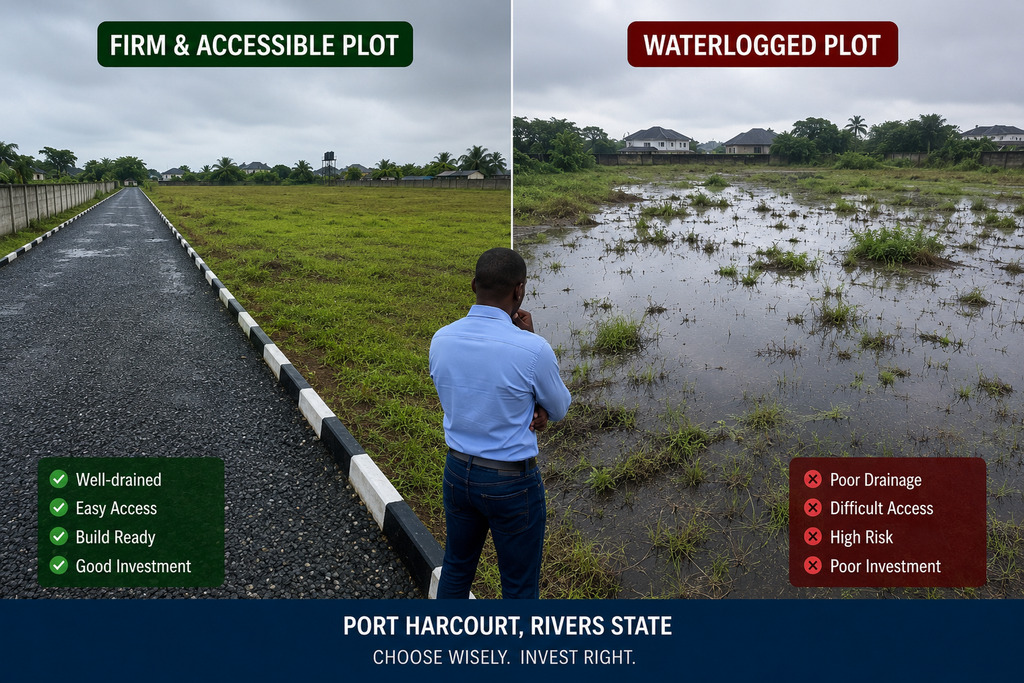
Somebody will carry you to land in Ozuoba by 11am in January, when the sun is doing press-up on everybody’s head, and tell you, “Madam, this place is 100 percent dry.”
You will stand there. Your shoe will not sink. The place will look innocent. Grass will be short. Breeze will even blow small. Then August will come, and that same land will start behaving like it has a private arrangement with the river.
This is why “dry land” and “wet land” matter in Rivers State.
Not because wet land is automatically useless. Not because dry land is automatically perfect. But because if you do not understand what you are paying for, you may buy land at one price and start paying for it again with filling, drainage, foundation work, delay, stress, and prayer points you did not plan for.
At BEMD, this question comes up a lot because Port Harcourt people have seen enough land stories to know that ground level is not vibes.
First, what do people mean by dry land?
In everyday Port Harcourt real estate talk, dry land usually means land that does not hold water, does not flood easily, sits at a reasonable natural level, and may not need serious sand filling before you can build.
It is the type of land agents like to call “table dry land.”
But please, do not let that phrase hypnotise you.
Dry land should not only be dry on the day you inspected it. It should make sense after heavy rain. It should have access. It should have drainage direction. It should not be sitting lower than the road in a way that makes every rainwater from the neighbourhood choose your plot as final destination.
True dry land gives you fewer surprises.
You may still need to clear it. You may still need to level parts of it. You may still need proper foundation advice. But you are not starting your project by first fighting nature.
So what is wet land?
Wet land, in the way many buyers use it, is land that is naturally low, waterlogged, swampy, marshy, or close enough to wet areas that water collects easily.
Sometimes it is obvious. You step in and your leg enters small. You see water plants. The ground smells damp. There are mosquito meetings everywhere. You already know.
Other times, wet land dresses well.
It may be dry on the surface because the rain has not fallen for weeks. It may have been lightly filled to make it look firm. It may be beside developed houses, so you assume it is safe. It may even be in a “hot” location where everybody is buying fast, and that pressure alone can make common sense start sweating.
In Rivers State, especially around Port Harcourt and its edges, land can change character from one street to the next. One side of Elelenwo may behave differently from another side. Same with Ozuoba, Choba, Alakahia, Eneka, Rumuodara, Igwuruta, Woji, Abuloma, and parts of Airport Road.
That is why asking “Is Ozuoba dry?” is not enough.
Which part of Ozuoba?
What road?
What elevation?
What happens there in August?
Where does the water go?
Who has built there and what did they spend before foundation?
These are the questions that save money.
Wet land is not always a bad buy
Let us be fair.
Some people have bought wet land, filled it properly, built well, and made good money from it. Some of the places people are rushing today were once land nobody took seriously. Development changes areas. Roads change areas. Drainage changes areas. Demand changes areas.
So the problem is not that wet land exists.
The problem is paying as if it is dry land when it is not.
A wet plot may be worth buying if the price reflects the work ahead, the title is clean, the access is good, the drainage plan is sensible, and you have the budget to do proper reclamation and foundation work.
But when somebody sells wet land to you with dry land language, that is where wahala starts.
Because after payment, the land will stop speaking English. It will speak water.
Why this matters before you pay anything
The first reason is cost.
A plot that looks cheaper can become more expensive than the one you rejected.
Let’s say you see land around the outskirts for ₦8.5 million or ₦15 million per plot, and another one in a more established part of town is ₦25 million or ₦35 million. On paper, the cheaper one looks like wisdom. Your chest may even rise small.
But if that cheaper plot needs heavy filling, proper compaction, drainage work, stronger foundation design, and repeated maintenance because water keeps coming back, the maths changes.
Sometimes the land was not cheap. It was only quiet about its real price.
The second reason is time.
If you buy dry, accessible land, you may be able to start planning your fence or foundation faster. If you buy wet land without preparing for it, your first one year may go into “let us fill it small first,” “let the water go down,” “let us wait until dry season,” “engineer said we need more laterite,” and other sentences that slowly age somebody.
The third reason is resale.
Buyers are wiser now. Everybody has heard stories. If you ever want to resell, serious buyers will ask the same questions you avoided. If your land floods, is hard to access, or needs too much work before development, that affects how quickly it moves and how strongly you can price it.
The fourth reason is peace of mind.
You can survive many things in Nigeria, but buying land and still being afraid of rain is not the life anybody prayed for.
How to spot wet land before you are carried away
Please, do not inspect land only in dry season.
Dry season inspection is like meeting somebody at a wedding. Everybody looks fine at a wedding. You need to know what happens on a stressful Tuesday.
If you can, visit after heavy rainfall. Not drizzle. Real Port Harcourt rain. The type that makes taxi drivers increase price with spiritual confidence.
When you get there, check the road first. Is the access road holding water? Are nearby compounds raised much higher than the road? Are fences stained with flood marks? Are gutters present or just promised in the estate brochure? Is the land lower than surrounding plots?
Then look at the vegetation.
Some plants like wet ground. If you see thick swamp grasses, raffia-like growth, water-loving weeds, or soft dark soil, do not pretend you did not see them. The land is giving you information.
Talk to people around.
Not only the agent. The agent may be honest, but the agent also wants to sell. Ask the vulcanizer. Ask the woman selling drinks. Ask the security man in the next compound. Ask, “This place dey flood?” and then keep quiet. People will talk.
Also check the buildings nearby.
If every house around is sitting on a very high base, that is not decoration. If everybody filled their land like they were building a small hill, respect the message.
Questions to ask before you pay
Ask these questions calmly. You are not fighting anybody. You are protecting your money.
Is this land naturally dry or filled?
If it was filled, when was it filled and with what material?
How many trips of filling were used per plot?
During rainy season, where does water collect?
Is there a drainage plan for the estate or area?
Is the access road passable in heavy rain?
Are neighbouring plots already built, and what foundation type did they use?
Can I come back after rain to inspect?
Can my surveyor or engineer inspect before I commit?
A serious seller may not like too many questions, but they will respect them.
A unserious seller will start rushing you.
“Someone else is paying this evening.”
“My oga said price will change tomorrow.”
“Don’t worry, all this place is dry.”
“Madam, you are overthinking.”
My dear, overthink. It is land. Not shawarma.
Documents still matter, even when the land is dry
Do not let dry land make you forget documents.
A plot can be dry and still have title issues. It can be firm and still be under dispute. It can have good road access and still fall inside a planning problem.
So after checking the ground, check the paperwork.
You want to see the survey plan. You want to confirm the coordinates. You want to understand the root of title. You want to know whether it is Deed of Conveyance, Registered Survey, C of O, Gazette, Excision, or whatever title is being presented. You want to verify that the land being shown to you is the same land on the document.
And please, do not be shy to ask for time.
Any land that is truly yours will survive 48 hours of proper checking.
Why agents like saying “dry land”
Because buyers understand it.
“Dry land” sells faster than “low land that may require filling.”
“Buy and build” sounds better than “buy, fill, compact, drain, wait, then build.”
This is not even always wickedness. Sometimes the agent is repeating what the owner told them. Sometimes the owner bought it years ago and never checked properly. Sometimes everybody in the chain is just hoping nobody asks too much.
But hope is not due diligence.
In Rivers State, water is part of the conversation. Port Harcourt is a wet city. Rainfall is not a visitor here. It is family. So when you are buying land, you are not only buying size and title. You are buying ground behaviour.
A small story Obinna did not find funny at first
Obinna had been eyeing land around the Ozuoba and Choba axis for almost two years. Every few months, he would ask for prices, save screenshots, compare locations, then go quiet again.
One Saturday, someone showed him a plot that looked cheaper than what he had been seeing. The road was not bad. The area was developing. The agent said the magic words: “dry land.”
Obinna almost paid commitment fee.
But something told him to return after rain. He did. The front road had water. The plot itself was not a swimming pool, but the back was soft. Two houses away, a man told him, “If you wan build here, budget filling well.”
That sentence saved him.
Not because the land was useless. It was not. But the price did not match the work it needed. He did not walk away because he was afraid. He walked away because he finally understood what he was looking at.
That is the difference.
How to think about price without deceiving yourself
A plot in Port Harcourt can be ₦10 million, ₦25 million, ₦45 million, or far more depending on location, title, access, size, neighbourhood development, and road position.
But land price is not only the amount the seller writes on paper.
The real price is:
Purchase price
Plus documentation
Plus survey and verification
Plus clearing
Plus filling, if needed
Plus drainage
Plus foundation implications
Plus time
Plus the rent you are still paying while you wait
This is where many people finally calm down and do the maths by themselves.
Because if you delay one more year out of fear, rent may still collect ₦1.5 million or ₦2.5 million from you, depending on where you live. If the plot you were watching moves from ₦18 million to ₦22 million because road work reached the area or demand increased, nobody will call it wickedness. They will call it market.
And if you rush into wet land without pricing the filling properly, the money may still leave you, only through another door.
Either way, the land conversation is not waiting for you to feel ready.
Before you pay, do this simple thing
Visit the land twice.
Once when it is convenient.
Once when the weather has misbehaved.
Go with someone who is not emotionally attached to the deal. Get a surveyor. Get an engineer if the land looks low. Ask residents questions. Look beyond the entrance. Walk the full plot. Check the back. Check the road. Check the gutter. Check the documents.
And if anybody says you are doing too much, smile.
You are not doing too much.
You are doing enough.
Final thought
Dry land and wet land are not just real estate vocabulary. They are budget vocabulary. They are timeline vocabulary. They are peace-of-mind vocabulary.
Before you pay for land in Rivers State, know what the ground is saying.
Because after allocation, receipt, and congratulations, it is you and that land that will be facing the rain together.
For verified land and property enquiries in Port Harcourt and across Nigeria:
Call or WhatsApp: 08033359028 / 08027746528
www.bemdproperties.com
info@bemdproperties.com
No. 32 Ebara Road, Orazi, Port Harcourt


